When Public Questions Became Part of the Meeting
When public questions became part of the meeting, audiences gained a recognized turn to challenge speakers and clarify decisions, though formats varied by place.
Public question periods became a recognizable feature of meetings as organized lectures, civic hearings, and mass communication gave audiences a distinct turn after a speaker’s presentation. There was no single invention or universal starting date: the practice took shape differently across institutions, and its history is clearest when tied to particular settings.
Public question periods
A formal question period is not the same as people asking questions in a gathering. The distinction is procedural: a chair or speaker explicitly pauses the main presentation and invites audience questions as part of the event.
That distinction matters because people have long exchanged questions and replies in assemblies, classrooms, religious gatherings, and civic meetings. Those varied practices do not, by themselves, establish when a separate question period became a standard feature. The evidence is better approached through specific institutions and formats than through a sweeping account of public discussion.
Lectures and audiences
Public lectures offer one visible setting for the format. In Britain and the United States, lecture societies and lyceum programs in the nineteenth century brought speakers before audiences on subjects such as literature, science, and public affairs. Some events included discussion after the address, making audience response part of the program rather than an informal exchange in the doorway.
The shift was not uniform: an announced discussion could be open-ended, while a later, more tightly chaired question period gave a moderator clearer control over who spoke and when. The format made a practical problem explicit. A speaker could address a large audience, but the audience needed a way to respond without turning the event into overlapping conversation.
In Britain, public meetings and political gatherings also developed conventions for audience participation, including questions directed to speakers. These were not identical to lecture-hall question periods: the purpose might be to challenge a public figure or press for an answer, rather than clarify a presentation. Such differences caution against treating “the public question period” as one practice with a single origin.
Hearings and public business
Government hearings provide another important strand. In the United States, legislative committees have held public hearings as a means of receiving testimony from witnesses; these proceedings are structured around committee members questioning witnesses, not necessarily an audience questioning a speaker. Public participation in civic meetings and hearings has taken other forms, including petitions, comments, and testimony.
That distinction helps explain why “questions at a meeting” can mean different things. A witness answering committee members is part of an official inquiry; a resident asking an official about a proposal is a public exchange. Both make questioning visible, but the roles and authority in the room differ.
Over time, civic forums and public meetings incorporated recognizable question-and-answer sessions alongside speeches, reports, or presentations. The change was gradual and local. It depended on the purpose of the gathering, its rules, and whether audience members were understood as listeners, witnesses, constituents, or participants.
Broadcast and remote formats
Broadcasting carried question-and-answer formats beyond the meeting hall. Radio and television programs could place a host or panel before questions from studio audiences, callers, or correspondents. The audience was no longer necessarily in the same room, while producers and hosts took on some of the work a chair might do at a public meeting: selecting questions, limiting turns, and keeping the exchange on air.
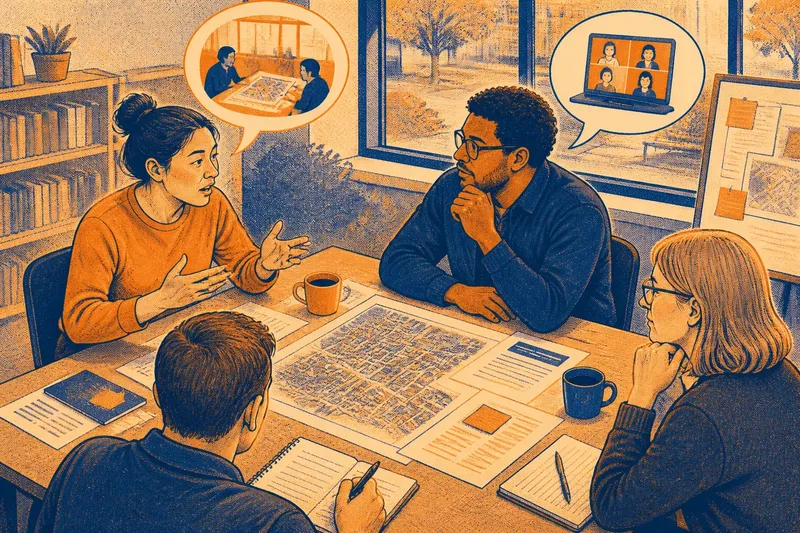
Remote meetings changed the mechanics again. Video-call hand-raising, chat boxes, and submitted questions let participants contribute without approaching a microphone, but the moderator still decides which questions reach the floor. The tools are newer; the underlying question of access—who gets heard, and under what rules—remains recognizable.
How did the format develop?
When did audience questions become formal?
There is no single date that applies across public life. Audience discussion appeared in different settings, while a formally scheduled question period emerged unevenly in lectures, civic forums, and other organized events.
Were public meetings the first setting?
No single setting can claim a universal beginning. Public lectures, political gatherings, educational events, and civic meetings each had their own ways of allowing questions, and their procedures were not interchangeable.
How did broadcasting change question periods?
Radio and television extended the exchange to listeners and viewers who were not in the room, using hosts, callers, or selected audience questions. That made selection and timing more visible parts of the format.
Are public comments the same as questions?
No. A public comment usually gives a person time to state a view, while a question seeks information or a response; some meetings allow both, under separate rules. The distinction depends on the meeting’s procedures, so the terms should not be treated as synonyms.
Formats and authority
Question periods did not simply add a polite closing to a speech. They gave the chair, moderator, or host a defined role in managing the exchange, and made the audience’s turn part of the event’s structure. That could invite scrutiny, but it did not necessarily give listeners power over a decision.
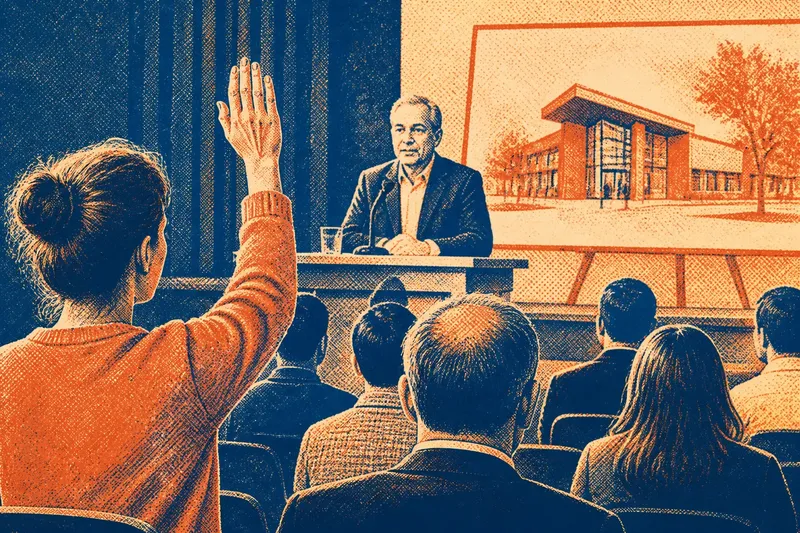
Consider an invented situation: a town library schedules a lecture about a proposed branch renovation, followed by audience questions. The agenda names the library director as the respondent and says the session will explain the proposal, not approve it; a resident asks why the entrance is shown on one side of the plan, and the director answers that the drawing is preliminary. The audience leaves with a clarified design detail, but not a decision about the renovation—an observable difference between getting an answer and having authority.
The history of when public questions became part of the meeting is therefore a history of changing formats, not a clean transition from silence to openness. A question period can make an audience’s turn visible, while its rules still determine who speaks, what can be asked, and what kind of answer the meeting can provide.